8 Bit Pcm Mono Wav File Download
GZ05: Multimedia Systems: Samples GZ05: Multimedia Systems: Audio Samples This page gives all the audio samples I played during the GZ05 lectures, and a few more that there wasn't time for. The speakers in the lecture theatres aren't the best, so some of the artifacts were not as clear as they might be. I suggesting listening in a fairly quiet environment, with a good set of headphones. Some of the sound clips are quite large. Most of the are given as.wav files (uncompressed PCM, either 8-bit or 16-bit) because any further compression might interact badly with the compression artifacts I want you to hear. These sound clips illustrate the effects of sampling and quantization noise (in the time domain).
Aliasing Effects Tone that increases from 50Hz to 8KHz, then decreases back to 50KHz again. The original 48KHz sampled file: 8 bit, mono, 384KB. Downsampled to 8KHz using a 4KHz anti-aliasing filter: 8 bit, mono, 64KB. Downsampled to 8KHz by simply taking one sample in six: 8 bit, mono, 64KB In the last sample, aliasing is clear, as for the middle part of the clip high frequencies above 4KHz have been 'folded' back into the lower 4KHz region.
Sampling and Aliasing of Music A clip from Jean-Michel Jarre's Equinox:. The original file, at 48KHz sampling: 2MB.
Downsampled to 8KHz using a 4KHz anti-aliasing (low-pass) filter: 2MB. Downsampled to 8KHz by simply taking one sample in six: 2MB The difference between the second and third clips is aliasing noise - sounds above 4KHz being sampled at 8KHz, and appearing as aliasing noise below 4KHz. Quantization Effects A simple tone, quantized to 256 linear levels, 16 linear levels, and 4 linear levels. 256 levels: 48KHz sampled, 8 bit, mono, 192KB. 16 levels: 48KHz sampled, 8 bit, mono, 192KB. 4 levels: 48KHz sampled, 8 bit, mono, 192KB As the number of levels is decreased, more square edges are introduced, and higher frequency quantization noise appears. These first set of clips give a basic comparison of speech codecs.
The phase ' A lathe is a big tool. Grab every dish of sugar.' , spoken in a quiet environment. This sentence is a bit strange, but it has a good mix of sounds including 'th' (lathe) and 'sh' (dish, sugar) which are unvoiced sounds, some difficult consonants 'b' (big), 't' (tool) and 'G' (grab), which are part voiced, part unvoiced, and the 's' in 'is' which is pronouced like a 'z' simultaneously voiced and unvoiced.
Sound files obtained from. Original PCM u-law 8KHz sampled, u-law, mono, 32KB. ADPCM (32 Kb/s) 8KHz sampled, u-law, mono, 32KB. CELP (4.8 Kb/s) 8KHz sampled, u-law, mono, 32KB. LPC10 (2.4 Kb/s) 8KHz sampled, u-law, mono, 32KB The next set of clips illustrate how well these codecs perform in a noise environment. Notice in LPC how the background noise sometimes triggers the wrong voiced/unvoiced decision by the codec.
This error is presumably also happening in CELP and G.729, but the residue coding mostly manages to compensate. I've lost the reference for where these came from - if you find them again, let me know so I can give credit. Original PCM 16-bit linear file (128Kb/s) 8KHz sampled, 16 bit linear, mono, 342KB.
G.729 (8Kb/s) 8KHz sampled, 16 bit linear, mono, 342KB. CELP (4.8Kb/s) 8KHz sampled, 16 bit linear, mono, 342KB. LPC10 8KHz sampled, 16 bit linear, mono, 342KB The third set of clips illustrates what happens when you try and code music with a low bitrate speech codec.
Pretty funny, but not very nice. I've lost the reference for where these came from - if you find them again, let me know so I can give credit. G.729 (8Kb/s) 8KHz sampled, 16 bit linear, mono, 87KB. LPC10 8KHz sampled, 16 bit linear, mono, 87KB Masking Effects These clips illustrate frequency masking effects in perceptual codecs. They consist of one low-amplitude tone that pulses on and off, and then a second higher amplitude tone that appears.
If the higher amplitide tone is loud enough and close enough in frequency to the first tone, the first tone becomes inaudible, and so a perceptual codec would not need to encode it. In all of these clips the louder tone is of the same amplitude - all that differs is the frequency. 550Hz quiet tone, 100Hz loud tone. Quiet tone is not masked. 48KHz sampled, 16 bit, mono, 2.3MB.
550Hz quiet tone, 200Hz loud tone. Quiet tone is not masked. 48KHz sampled, 16 bit, mono, 2.3MB. 550Hz quiet tone, 500Hz loud tone. Quiet tone is masked. 48KHz sampled, 16 bit, mono, 2.3MB.
550Hz quiet tone, 1000Hz loud tone. Quiet tone is not masked. 48KHz sampled, 16 bit, mono, 2.3MB These two clips illustrate that noise can be more effective at masking than a pure tone of the same amplitude. In these, the same 550Hz tone pulses on and off, but instead of a loud tone, loud narrowband noise is used. The noise does not need to be so loud to mask the 550Hz tone. 550Hz quiet tone, 500Hz narrowband (25Hz bandwidth butterworth filter) noise. Quiet tone is masked.
48KHz sampled, 16 bit, mono, 2.3MB. 550Hz quiet tone, 1000Hz narrowband (25Hz bandwidth butterworth filter) noise. Quiet tone is not masked. 48KHz sampled, 16 bit, mono, 2.3MB MP3 Encoding Several clips to illustrate MP3's noise behaviour. At 192Kb/s, MP3 is pretty comparable with CD quality. At 128Kb/s I can hear the difference, but only when listening on good speakers or good headphones. Different people seem to have different thresholds for hearing MP3 compression artifacts.
At lower bitrates, MP3 artifacts become very noticable. At 64Kb/s, MP3 would normally have reduced from a 44.1KHz sample rate down to a 22.05 KHz sample rate, sacrificing higher frequencies to avoid introducing unacceptable noise in the more important lower frequencies. In these samples, I've forced LAME to maintain a 44.1KHz sample rate so the artifacts become more noticable. Once you've heard them at 32KB/s, then you start to understand what sort of effects to listen for at higher bitrates.
Mendelssohn at 128Kb/s. 44.1KHz sampled, Joint stero encoding, 908KB. Mendelssohn at 64Kb/s.
44.1KHz sampled, Joint stero encoding, 908KB. Mendelssohn at 32Kb/s. 44.1KHz sampled, Joint stero encoding, 908KB Ogg Vorbis Encoding Finally a comparison between MP3 and Ogg Vorbis at 64Kb/s. At this data rate, MP3 has reduced the sample rate to 22.05KHz, whereas Vorbis is still using 44.1KHz, so the main difference is a loss of higher frequencies. But compare this to the Mendelssohn MP3 above sampled at 44.1KHz and compressed to 64Kb/s, where the artifacts are obvious and annoying. Sound clips taken from. Ogg Vorbis Compilation at 64Kb/s.
44.1KHz sampled, Joint stero encoding, 12MB. MP3 Compilation at 64Kb/s. 22.05KHz sampled, Joint stero encoding, 6MB.
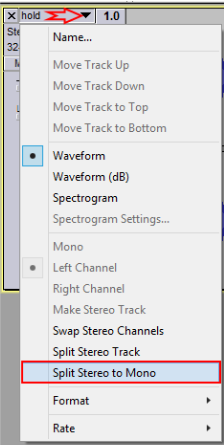
Go into the edit drop-down menu and select preferences, and switch to the File Formats tab. Here, set the Uncompressed Export Format to 'WAV (Microsoft 8 bit PCM)'. Additionally, you will also want to go into the Quality tab and set Real-time dither and High-quality dither to 'None'. Now when you export as a WAV, the result can be converted to the DooM WAV format correctly once you import it into your wad. As for how to get a mono track from a stereo one, what I do is go into the menu on the name of the sound effect shown to the left of the waveform(and to the right of the x button for that sound), and select 'split stereo track' to get the left and right tracks separated. Once you've done that, you can use the same menu(there is now one for each track) to set the left and right tracks set to 'mono'.
8 Bit Mono Wav

8 Bit Wav Files
Now you have the choice of either deleting one and exporting, or halving the volume on both tracks and exporting with both mono tracks layered on top of each other; just do whatever sounds best. As for how to get a mono track from a stereo one, what I do is go into the menu on the name of the sound effect shown to the left of the waveform(and to the right of the x button for that sound), and select 'split stereo track' to get the left and right tracks separated. Once you've done that, you can use the same menu(there is now one for each track) to set the left and right tracks set to 'mono'. Now you have the choice of either deleting one and exporting, or halving the volume on both tracks and exporting with both mono tracks layered on top of each other; just do whatever sounds best.or you can click the stereo track, click 'Tracks' in the menu bar, and then 'Stereo Track to Mono'.
Comments are closed.